

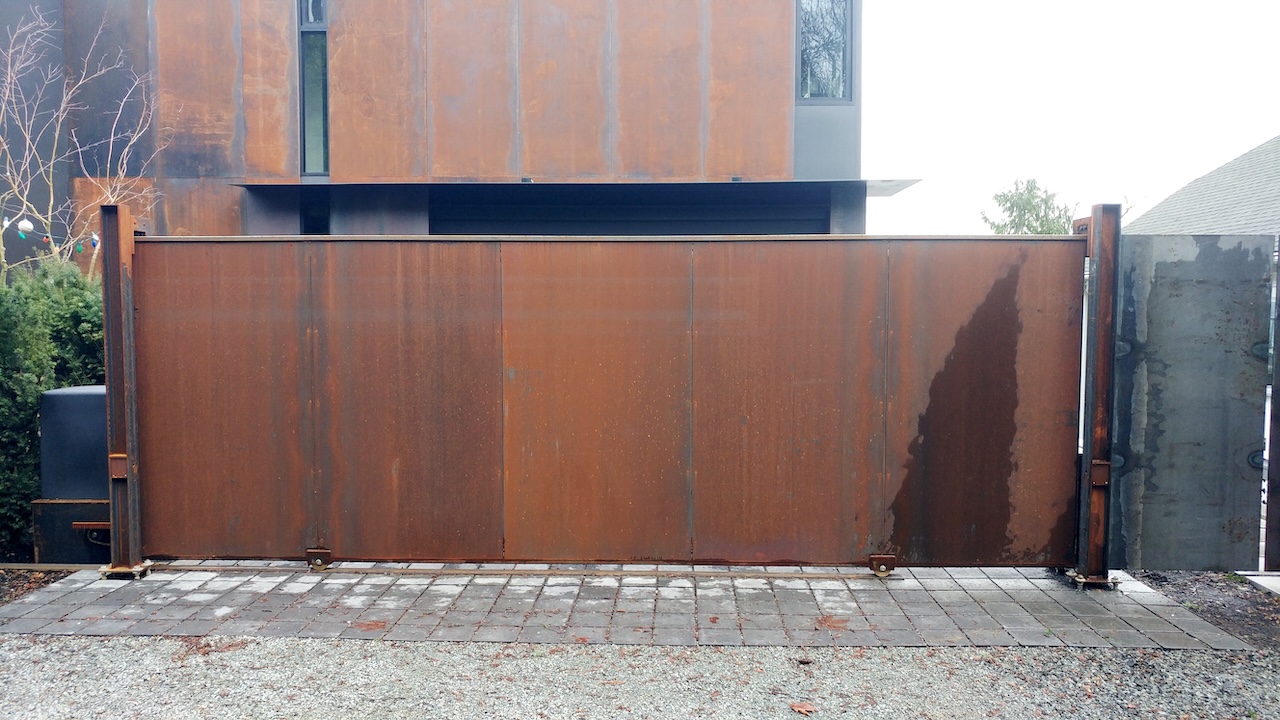
Automated driveway gates are extremely useful, offering homeowners convenience, privacy, security, and peace of mind. However, they are also large, heavy objects that take a great deal of power to start and stop. Without appropriate safety equipment, an automated solid-steel driveway gate weighing close to 1,000 pounds can trap and crush an arm or even result in fatality. It can do serious damage to a vehicle, bicycle, or toys that obstruct the gate’s path. Safety must be the number one priority in the fabrication and installation of these considerable systems.
Driveway Gate Safety Design Principles
Automated driveway gate safety design principles follow those for garage doors and opening systems. They are the subject of two reference safety standards, UL 325 and ASTM F2200, which are the result of decades of engineering experience. Today’s automated gate safety systems work together to prevent entrapment and pinching, detect obstructions or dangerous situations, and immediately stop or reverse gate movement if an obstruction is detected.
ASTM F2200: Design and Layout Safety Recommendations
ASTM F2200 outlines hundreds of automatic vehicle gate design elements to prevent entrapment and injury with specific safety features for typical sliding or swinging driveway gates. For example, ASTM F2200 requires that the gate’s vertical pickets be placed no more than 2¼ inches apart, ensuring no human body can pass through. Also, a sliding gate must have sensors installed to reduce the risk of entrapment. The guidelines also dictate how gate rollers must be covered to prevent injury at ground level.
UL 325: Mechanical Safety Features
UL 325 addresses safety requirements for a gate’s mechanical operation, including motors and stop sensors. It requires at least two independent, monitored “entrapment protection devices” (e.g., photo eyes or edge sensors) to automatically stop or reverse movement when an obstruction is detected.
The key safety components for gate operation are:
- Photo eye sensors, which create an invisible beam across the gate opening path. If the beam is broken during active gate operation, the gate’s motor stops and reverses.
- Safety edge sensors, which are pressure-sensitive strips attached to the gate’s leading edge. If the gate contacts an obstruction (e.g., a person, an animal, a bicycle, a toy, etc.), the sensor immediately signals the gate motor to stop and reverse.
- Force sensing, in which the gate will stop or reverse if the motor senses resistance beyond a normal level.
- Vehicle loop detectors, installed beneath the driveway surface, sense the presence of a vehicle. They are often installed in front of and behind a gate. When behind the gate, they typically trigger the driveway gate open automatically as a vehicle approaches to exit.
- Emergency manual operation: the gate can be operated by hand during a power outage or a mechanical issue.
Driveway Gate Safety Q & A
Q. Are the UL 325 and ASTM F2200 standards enforced by law?
A. No. These independent safety guidelines are recommended standards for the automatic gate and garage door industry. Reputable gate manufacturers and installers voluntarily follow these standards. Before hiring a driveway gate company, consumers should ask about their safety practices and whether they follow the UL 325 and ASTM F2200 guidelines.
Q. Which represents a greater safety risk: A sliding gate or a swinging gate?
A. While both are solidly built and can be quite massive, the sliding gate can present more risk. Picture an object behind an operating swinging gate. Most likely, the motion will cause it to push the object out of the way. In contrast, if an object is in the path of a sliding gate, the gate could trap that object. Without the proper safety components, it could crush an object in its path.
Safety Questions to Ask Before You Hire a Driveway Gate Company
Ask these questions before you select a driveway gate company to provide, fabricate, or install your driveway gate.
- What basic safety standards will be incorporated into the operator and gate that you will install for me? Will you use brand-name components that meet the UL 325 safety standards?
- Manufacturers state in their manuals that a trained professional must install their gate components. What training has your installer completed? How many years of gate installation experience does your installer have?
- To avoid finger-pointing, ask whether the gate fabricator will also install the gate.
- Automated driveway gate systems require substantial electrical wiring and often connect to the home’s main electrical supply. Are your installers licensed electricians?
Reputable Driveway Gate Companies Adhere to Safety Recommendations
The team at Automated Gates has been designing, fabricating, and installing residential, community, and commercial driveway and pedestrian gates since 1980. Several employees in our design, fabrication, and installation departments have safety certifications. All of our gate designers, fabricators, and installers are committed to gate safety, so you, your loved ones, and your guests can use your gate with peace of mind.
Complimentary Site Visit
The gate experts at Automated Gates and Equipment are available for a complimentary site visit at your home, community, or business to discuss your needs and concerns. Call us today at (206) 767-9080 or contact us online to speak with a gate expert and schedule a site visit.
Citations
- UL – UL 325 External Entrapment Protection Devices
- ASTM – F2200-24 Standard Specification for Automated Vehicular Gate Construction
- AEGates – Residential Driveway Gates
- AEGates – Community Gates
- AEGates – Commercial Gates.